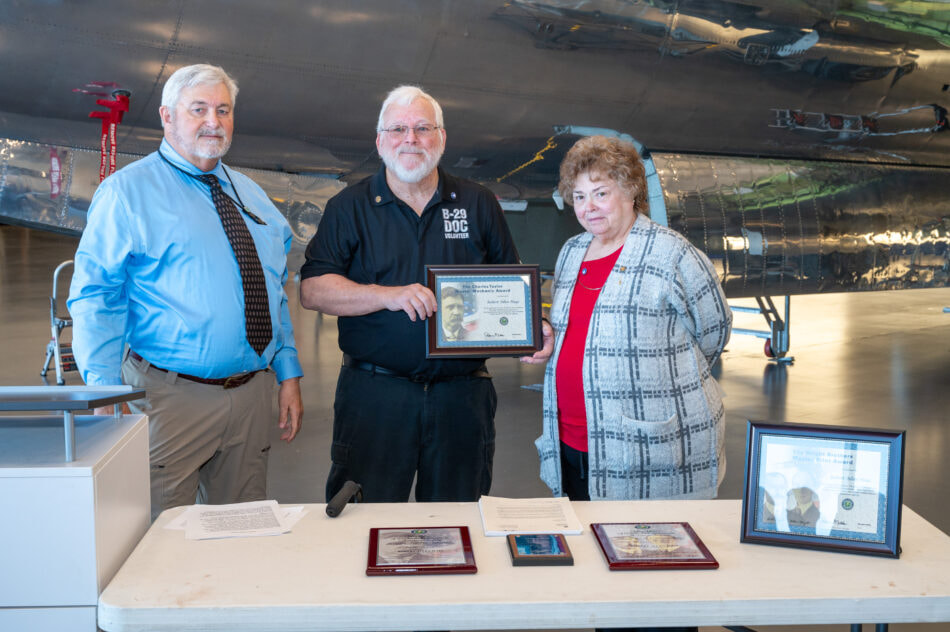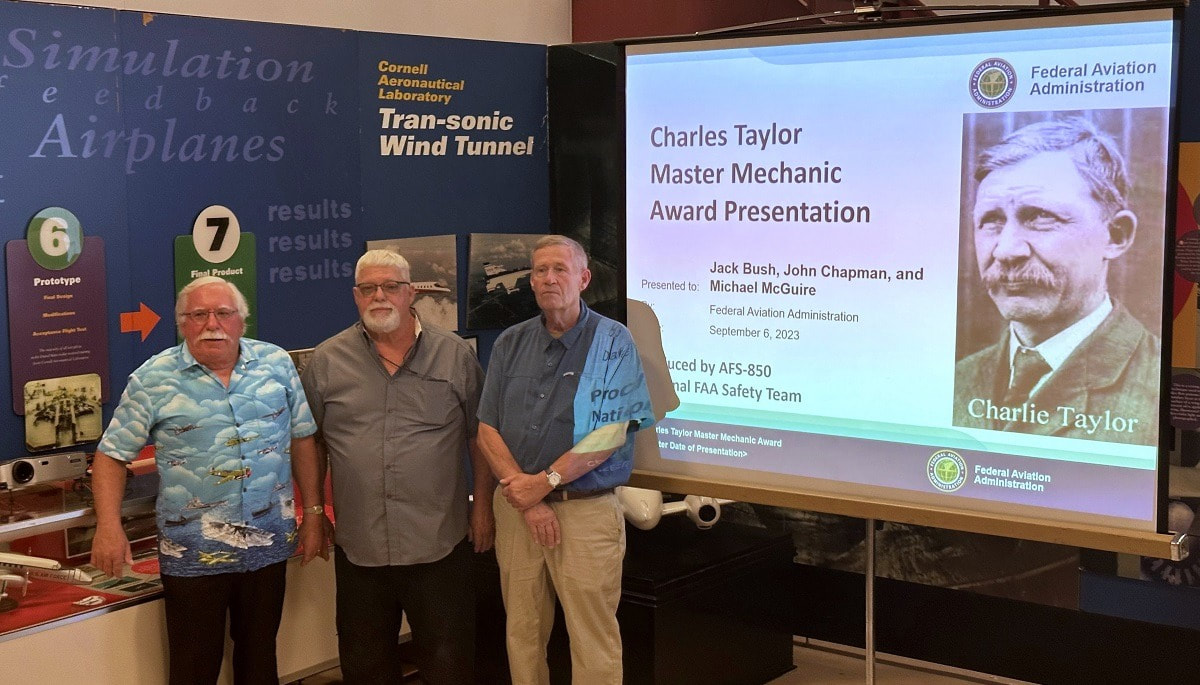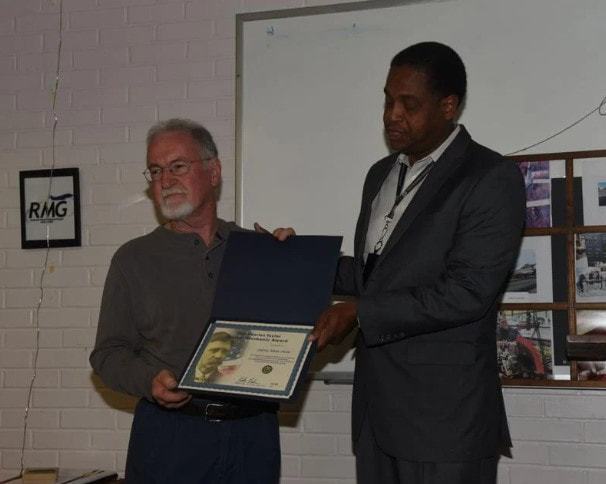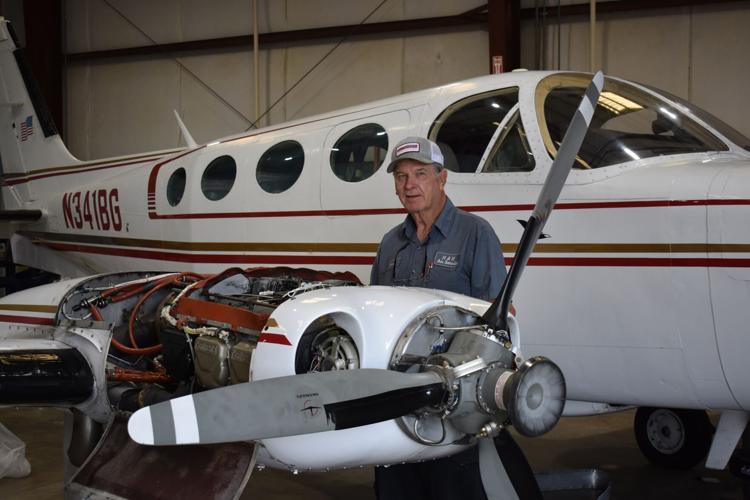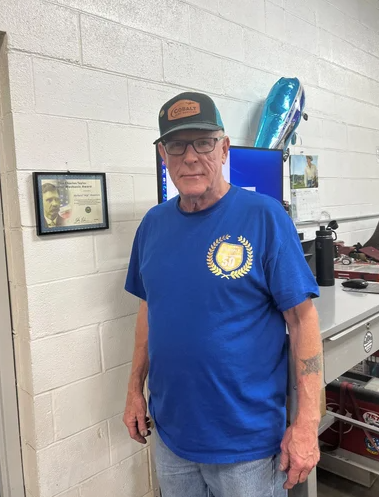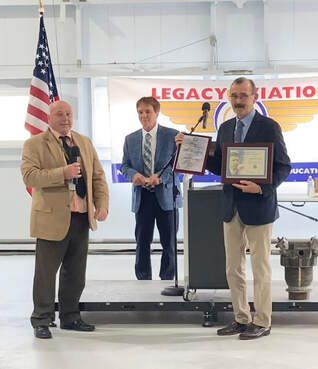
Bill Bridges, founder of The Flight Shop in Brigham City, is still turning wrenches and working on airplanes at 82 years old. In fact, in September 2025, he was given the Charles Taylor Mechanic Award from the Federal Aviation Administration for 50 years of servicing and repairing airplanes. The FFA said The Charles Taylor Master Mechanic Award was named in honor of Mr. Charles Taylor, the first aviation mechanic who built the motor for the Wright brothers’ first powered flight. “I was surprised they kept the award a secret until they gave it to me,” Bridges said. “I told them I was getting ready to leave and they told me to stick around. They started setting up tables and invited some of my friends. Then they gave me the plaque.” The award is prominently displayed in the office. “People think you have to work for the airlines to make a living as an airplane mechanic,” he said. “We’ve made a pretty good living working on airplanes right here.” They had the first license he received in 1968 up until his last one. “They had all my licenses compiled,” Bridges said. “I am one of 3,500 other aviation mechanics across the country to have this award.” The Charles Taylor Master Mechanic Award recognizes the lifetime accomplishments of senior mechanics. “It’s a huge deal,” said his daughter Liz Hansen, who works at The Flight Shop, her father’s airplane maintenance and repair business. “In 1968 he got his first license for airframe, and powerplant repair for airplanes and he has received one every year since then.” “Craig Hulse started working with Bill out of high school and became a successful mechanic,” Liz said. “He is now taking most of the mechanical duties.” As a family-built and privately owned business that prioritize large-scale capabilities with small-shop attention, their technicians are IA and A&P certified and are experienced enough to handle most critical service needs and still care about every detail. Read the full article here.
0 Comments
In October 2020, James “Jim” Marvin earned the Charles Taylor Master Mechanic Award. The Charles Taylor Master Mechanic Award is an honor presented by the United States Federal Aviation Administration in honor of Charles Taylor, the first aviation mechanic in powered flight. The award recognizes the lifetime accomplishments of senior aviation mechanics. Taylor served as the Wright brothers’ mechanic and is credited with designing and building the engine for their first successful aircraft. James “Jim” Marvin served in the United States Air Force for 20 years as an aircraft mechanic and also worked as an aircraft mechanic, supervisor and Chief Inspector with Piedmont Airlines for 30 years. Working 50 years in aviation maintenance and spending a minimum of 30 years as a Federal Aviation Administration (FAA)-certified mechanic. During his time in the military, Jim worked on B-52 aircraft in Rome, New York and 135 refueling aircraft in Goose Bay, Labrador, Canada. After re-enlisting, Jim was stationed at Dover Air Force Base, Delaware where he served 16 years working on C-5 cargo planes and obtained his Airframe and Powerplant license. He retired as a Master Sergeant. Jim later joined Piedmont Airlines on August 15, 1990 as a mechanic in Salisbury, Maryland. He began his career with Piedmont working on the aircraft that remained overnight and was later promoted to several positions of increased responsibility including RON Maintenance Supervisor, Quality Control Supervisor and the position of Chief Inspector which he held for fifteen years. In 1952, at the age of seven, John Gilbert’s family relocated to Brooklyn from their home in South Carolina. John graduated from East New York High School in 1963 with a Technical Diploma in Aviation Technology. The following October, he enlisted in the U.S. Air Force and graduated from Chanute Air Force Base as a Multi-Jet Engine Aircraft Technician on March 24, 1964, at 19. Assigned to Loring Air Force Base, Maine, in the 42nd Organizational Maintenance Squadron, an attachment of the Strategic Air Command (SAC) 42 Bomb Wing, John was assigned to three different Vietnam temporary duty assignment missions between 1964 and 1966. Aircraft participated in air refueling missions to cover U.S. fighters and bombers flying in the theater of operation. He was promoted to KC-135 Crew Chief and honorably discharged in October 1967. Shortly after, Pan American Airlines hired him as an aircraft cleaner at JFK International Airport and promoted him to mechanic’s helper. As a licensed A & P and Radio Technician, Gilbert also worked in the Pan Am Avionic Department. In 1987, he was promoted to work in the Maintenance Control Operation (as a Repetitive MEL Supervisor) and remained in that position until Pan Am declared bankruptcy in December 1991. He remained in his position and was asked to answer phone calls until January 1992. Some two months later, “I started another path on my journey within the commercial aviation industry, working with Northwest Airlines Technical Operations Department in Minneapolis, accepting a position within the company’s Maintenance Control Operations as a Maintenance Operations Technical Representative (MOTR). My position required that I examined repetitive aircraft system faults and design specific troubleshooting and corrective action procedures for the problem, “said Gilbert; he held the position until July 1997 and was promoted to Northwest’s Line Maintenance Manager for Newark (EWR) and Philadelphia (PHL) Airports, a position that he held until retirement from the company in 2005. In September of that same year, North American Airlines, a contract charter operation, hired him as Manager of Maintenance Control until the company’s bankruptcy in 2013, whereupon he officially retired. Mr. Gilbert received the Charles Taylor award in 2017. The Hon. John J. Goglia recalls how proud he was when he got his Airframe and Powerplant Certifications after graduating from East Coast Aero Tech in Bedford, Massachusetts in 1963. With his A&P license in hand, he signed on for his first job as a mechanic for United Airlines. “New York has always been special to me because that is where I started my career at United Air Lines at JFK Airport. It was during the Jet Age, and jets were just starting to be worked on. Getting up to the line and working on a jet airplane was always a thrill for us young guys stuck in the hangar,” said Mr. Goglia in an interview with Metropolitan Airport News. Mr. Goglia worked for United at JFK until the airline laid off several mechanics in 1965. He went on to work for the airline in Washington, D.C., and then onto Baltimore. In between that time, he married a girl from Boston who was very close to her family in Massachusetts. Wanting to move back home to Massachusetts, Goglia searched for the only job he could find in Boston as a mechanic, and he was hired by Allegheny Airlines. “I went with Allegheny, and it actually changed my career because Allegheny treated their maintenance people a lot differently than United, and so I grew with Allegheny over the course of the next 30 years. They gave me freedom, and I ended up doing a lot of jobs that typically a mechanic for other airlines may never get to do…on the quality side, on special projects, as an inspector, a crew chief, all kinds of jobs within the maintenance department.” Allegheny went through several mergers with Lake Central, Mohawk, Pacific Southwest Airlines, and then Piedmont. Goglia got on a committee over people assigned to work the mergers before they took place, doing many tasks, other than turning wrenches, to bring the two companies together. In the course of his career, Goglia worked on many types of aircraft, starting with the DC-6, DC-7, 8, 9s, Convairs, Caravelles, 720s, 727s, 747s, and the BAC-One Eleven. He also worked the non-scheduled side of the house. “I had two jobs, looking for extra income… with three kids, and I worked the Lockheed air terminal. When Allegheny became U.S. Airways, some of the unique jobs Goglia had took him to Washington, D.C. He worked with the FAA for several years, reviewing flight safety and maintenance rules. This work got him noticed and allowed him to put his name in for a position with the NTSB (National Transportation Safety Board). Shortly after Goglia received a call from the White House and was subsequently Presidentially-appointed under the Clinton Administration as an NTSB Board member, serving in that role from 1995-2004. John Goglia received the Charles Taylor Master Mechanic Award after 53 years as a certificate holder in March 2017. At the time, he was promoting other people for the award. He said, “When you do that, you tend not to make accolades for yourself. It was secretly done behind my back, so I was surprised with the award at a competition I run called the Aerospace Maintenance Competition which took place a few years ago. My family flew down, and it was a big event. They had me crying.” Goglia reflected upon how FAA national resource specialist, the late Bill O’Brien, pushed hard to get the Charles Taylor Master Mechanic Award in place and how O’Brien really made it happen through his dogged determination and keeping it alive until somebody in the FAA thought it was a good idea and moved it forward. “Mechanics just do their job…a mechanic’s attitude is “see problem, fix problem, next problem,” said Golia, adding, “The Award is very important for the mechanics in general because it is one of the few forms of recognition that you have for a career, an unblemished career, because if you have problems with enforcement, you’re not going to get it. You have to have a clean record. It’s a tribute to what you’ve accomplished over the course of your career.” Note: The author of this article is Metropolitan Airport News. They want to thank Charles Taylor II, Ken MacTiernan, and Joshua Lang for their assistance with this article. The FAA’s most prestigious award for pilots is the Wright Brothers Master Pilot Award, and for aircraft mechanics, is the Charles Taylor Master Mechanic Award. The first 19 minutes of the video show a documentary of Orville and Wilbur Wright and mechanic Charles Taylor, who are credited with inventing, building, and flying the world's first successful airplane. It then details the requirements for the master pilot and master mechanic awards. This is the video shown preceding an award presentation ceremony.
Nominate a Master Mechanic: https://www.faasafety.gov/content/MasterMechanic/ The Charles E. Taylor Master Mechanic Award is presented by the Federal Aviation Administration (FAA). This award is presented to mechanics with both 50 years in aviation maintenance and 30 years FAA certified. Charles E. Taylor built the first aircraft engine used by the Wright Brothers in 1903. In addition, Aviation Maintenance Technician (AMT) day is May 24, his birthday. On this day, AMTs are celebrated everywhere for their challenging work and dedication to the aviation industry. This year, Aviation Institute of Maintenance –Norfolk instructor Ken Wiley was awarded the Charles E. Taylor award on AMT Day in front of his family, students, and fellow instructors. Ken Wiley has been an AIM instructor since 2008, however his experience in the industry goes back half a century. His experience started as an apprentice aircraft mechanic in 1971 at the Naval Air Rework Facility in Norfolk, Virginia. After graduating from the apprentice program in 1975, he worked his way up the ranks and became a lead aircraft mechanic, and later an Aircraft Engineering Technician at the Naval Air Rework Facility. In 1984, Wiley earned an FAA commercial pilot certificate with Instrument rating. In addition to serving at the Naval Air Rework Facility, he worked part time as a jump plane pilot at Suffolk Sky Sports in Suffolk, Virginia, taking skydivers up for parachute jumps. In 2003, he earned his FAA Private Pilot Certificate. His work as an aviation mechanic has brought him up and down the east coast as far as Naval Station Mayport in Jacksonville, Florida. In Mayport, Wiley provided technical support to Seahawk Helicopter operating squadrons. After retiring from government service in 2008, Wiley returned to Hampton Roads to AIM and has consistently inspired students with his extensive knowledge and experience in the industry. More recently, Wiley earned a FAA Remote Pilot Certificate (drone pilot) in 2017. Ken Wiley’s career in aviation came full circle when he received the highest honor for maintenance technicians. Instructors like Ken Wiley offer students an example of where a career in aviation can truly take you. Joe Lienau, a Sturgeon Bay native who lives in Fish Creek, was recently awarded the Federal Aviation Agency’s (FAA) highest, most prestigious awards: the Wright Brothers Master Pilot Award and the Charles Taylor Master Mechanic Award.
The awards recognize 50 continuous years of exemplary aviation flight experience, professionalism and steadfast commitment to aviation safety. Fewer than 1% of all pilots and mechanics in the United States have ever received both awards. Lienau is one of two recipients in Wisconsin. Jurg Grossenbacher of the Milwaukee Flight Standards District Office presented Lienau with the awards during a Wisconsin Department of Transportation conference in Fond du Lac, Wisconsin. Lienau was an American Airlines captain who retired after 35 years of service. He still flies his own airplane, and he’s a certified flight instructor and aircraft mechanic. Dale Arthur Meiler, floor inspector at Banyan Air Service, was recently honored as a recipient of the Charles Taylor Master Mechanic Award from the Federal Aviation Administration (FAA). Meiler is one of only 3,018 recipients of The Charles Taylor Award, the most prestigious FAA award to an aviation maintenance technician. Named in honor of Charles Taylor, the first aviation mechanic in powered flight, award recipients are required to have 50 years of civil and/or military maintenance experience with no violations. Meiler began his aviation maintenance career in the U.S. Army as a helicopter mechanic and served in the Vietnam War. After the military, he graduated from Embry–Riddle Aeronautical University with his A&P License. Meiler joined Banyan Air Service in Fort Lauderdale, Florida, on Sept. 9, 1983, as the lead technician. During those early years, Meiler was crucial to Banyan’s maintenance department’s certification because of his experience and relationship with the FAA. He added quality into the inspection process and increased awareness, safety, and efficiency for the entire MRO department as the Floor Inspector. “It was an honor and a pleasure to work with a man of Dale’s caliber. His professionalism and integrity served as bookends to his core commitment to quality and our customers’ safety,” said Lewis Homsher, quality manager of MRO Services at Banyan Air Service. Meiler has mentored countless junior technicians and has been promoted to several positions of increased responsibilities during his 37 years with the Banyan team. Dale was also the recipient of the NATA Technician of the Year award in 2006. Banyan is proud to have been a part of Dale’s invaluable career in the aviation industry and congratulate him on his retirement. NetJets Maintenance Technician Justin Siak recently received the Charles Taylor “Master Mechanic” Award, for 50 years in aviation maintenance, from the Federal Aviation Administration.The award ceremony was held on Aug. 15, 2015 and the audience included Justin’s family, present and former co-workers and representatives from the greater aviation community.
Mark Harden, FAA FAAST Team Coordinator for the Columbus, Ohio FSDO presented the award. Justin began his aviation career in 1962 as an Aviation Machinist. He served as a Troubleshooter in the VS-22 “Checkmates”, anti-submarine warfare squadron aboard the USS Lake Champlain, USS Wasp and USS Essex. Following his military service, he attended Pittsburg Institute of Aeronautics and was hired by Delta Airlines as a Line Maintenance Technician in 1969. After retiring from Delta in 1999, he joined NetJets, Inc. where he currently serves as an AMT. TRIBUTE TO THOMAS H. WARDLEIGH
Ms. MURKOWSKI. Mr. President, I pay tribute to Mr. Thomas H. Wardleigh, Alaskan aviation legend, who left us for new horizons on July 7, 2004, following a long battle with cancer. A World War II Navy veteran, Tom moved to Alaska in 1951 and continued his aviation career as a mechanic with the U.S. Fish and Wildlife Service, keeping its fleet of Grumman aircraft in operation for decades. He completed his federal service at the Federal Aviation Administration. He then devoted the rest of his life to promoting safety enhancements for Alaskan aviation. In 1984 he became chairman of the Alaskan Aviation Safety Foundation and produced more than 1,000 weekly episodes of a TV show called ``Hangar Flying'' which was broadcast all over Alaska. Because of the value of the instruction, the national organization, Aircraft Owner and Pilots Association, recently gave a grant to the University of Alaska Archives to transfer all of the programs to DVD so that future aviators will be able to learn from his timeless wisdom. Tom Wardleigh logged over 33,000 flight hours in numerous types of aircraft. He was in great demand as an advanced flight instructor, and was one of the few multiengine sea plane instructors. Many, many Alaskan pilots were Tom's students over the years. Although he was a tenacious fighter, Wardleigh was soft spoken, friendly, and always a gentleman, perhaps some reasons he was such a successful advocate for aviation safety enhancement, whether in education or technology. He was most recently instrumental in the development of the FAA Capstone Project which has been credited as a significant factor in lowering the accident rate in rural Alaska. While his work was primarily in Alaska, Tom participated in forums and projects all over the United States as well as in other countries whose aviation leaders often came to Alaska to personally seek Tom's advice on developing their safety programs. he list of commendations Tom had received over the years is long, and includes AOPA's Laurence P. Sharples' national award in 1994 for his lifetime of service. Last year, FAA Administrator Marion Blakey personally recognized Tom with one of the agency's most significant honors in U.S. civil aviation, the Distinguished Service Award--this in addition to having previously bestowed on him the Charles Taylor Master Mechanic and the Wright Brothers' Master Pilot Awards. While Tom Wardleigh may have taken his last flight, pilots and passengers alike will fondly remember this special aviator as they turn onto Wardleigh Drive at the Anchorage Ted Stevens International Airport. [From the U.S. Government Publishing Office, www.gpo.gov] [Congressional Record (Bound Edition), Volume 150 (2004), Part 13] [Senate] [Pages 17062-17063] |
The Charles Taylor Master Mechanic Award is named in honor of Mr. Charles Taylor, the first aviation mechanic in powered flight. The Charles Taylor "Master Mechanic" Award recognizes the lifetime accomplishments of senior mechanics. Mr. Taylor served as the Wright brothers' mechanic and is credited with designing and building the engine for their first successful aircraft.
Archives
January 2026
Categories |


RSS Feed